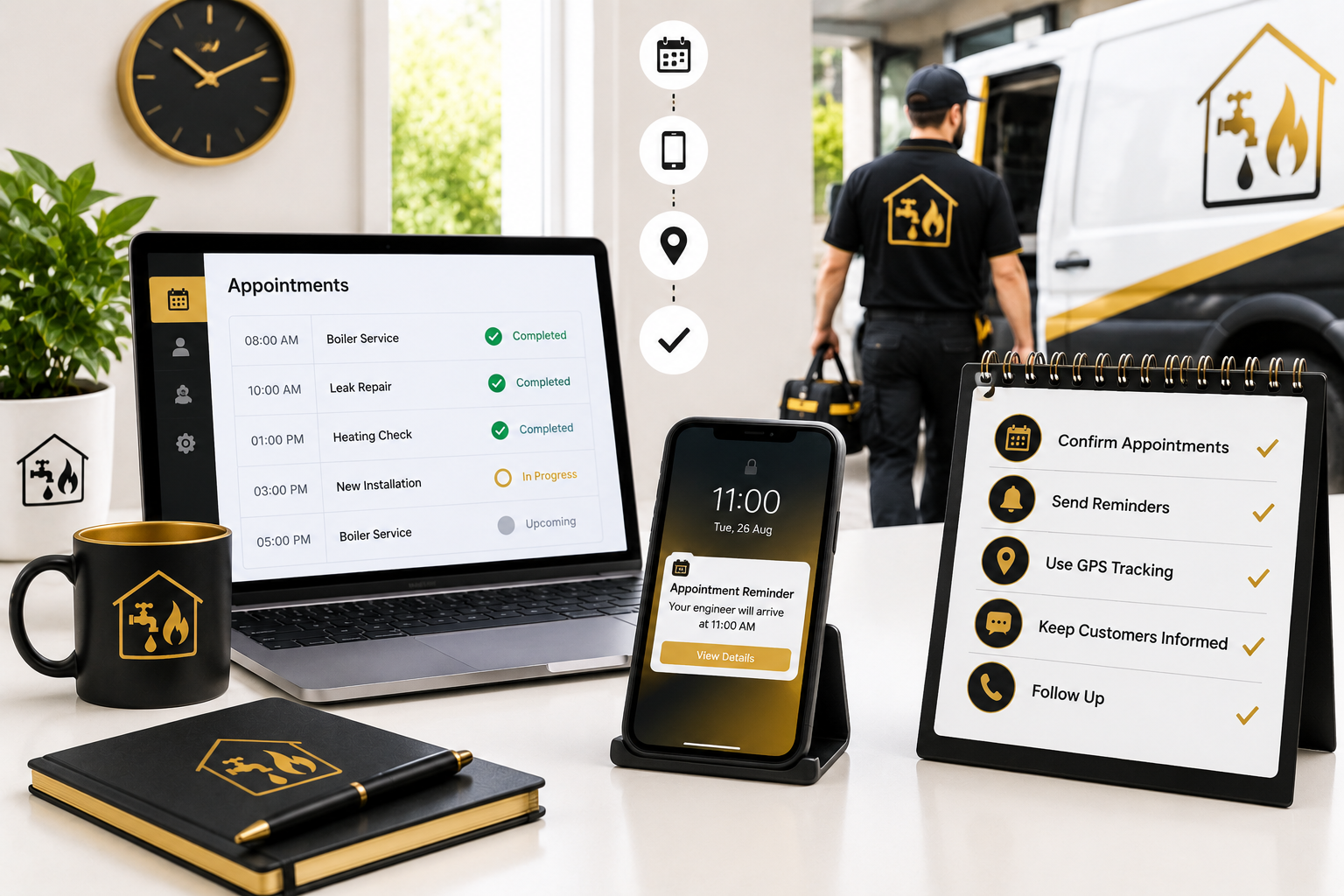
An engineer arriving at an empty house for a booked appointment isn’t a minor inconvenience, it’s a wasted slot, wasted travel, and often a knock-on delay for every job booked after it. How to reduce missed appointments comes down to two things working together: reminding customers properly, and having a clear policy for when they still don’t show.
This guide covers both sides, built for plumbing, heating, and HVAC businesses running appointment-based work rather than walk-in or emergency-only callouts.
At a Glance
| Best for | Plumbing, heating, gas, drainage, HVAC, or installation businesses booking scheduled appointments, servicing, and installations |
| Difficulty | Low, mostly a change in communication timing and a clear written policy |
| Time required | 1–2 hours to set up reminder timing and write a missed appointment policy |
| Expected business impact | Fewer wasted slots and less disruption to the rest of the day’s schedule |
Why Missed Appointments Cost More Than They Seem
A single missed appointment rarely feels like a big loss in the moment, but the real cost is compounding, the wasted travel time, the empty slot that could have gone to another customer, and the delay it often causes for every appointment booked after it. For an appointment-based plumbing or heating business, a handful of no-shows a week adds up to a meaningful amount of lost, unrecoverable capacity over a year.
Appointment Reminder Strategies That Actually Work
Not all reminders are equally effective. A reminder sent a week in advance is easy to forget by the time the appointment arrives; one sent the evening before or the morning of is far more likely to actually change behaviour.
- Timing matters more than the channel, a well-timed reminder the day before, and again on the morning of the visit, catches most people who would otherwise forget
- Text messages get read quickly, most people check a text within minutes of receiving it, which makes it a genuinely reliable channel for a same-day nudge
- Keep the message specific, include the time window, the type of job, and a way to reschedule easily, rather than a vague generic reminder
- Make rescheduling easy, not just possible, a reply-to-reschedule option catches people who know they can’t make it but haven’t got round to calling
Confirming the Right Contact Channel Before the Job
A reminder is only useful if it reaches the customer through a channel they actually check. Some customers respond fastest to a text, others to a phone call, and increasingly, some prefer WhatsApp.
Setting a Clear Missed Appointment Policy
Reminders reduce no-shows, but they won’t eliminate them, so a clear policy matters as a backstop. State your missed appointment terms clearly at the point of booking, whether that’s a deposit for larger jobs, a call-out charge if the engineer arrives and nobody’s home, or a simple request for reasonable notice to reschedule.
Reducing No-Shows With Better Scheduling Communication
Some missed appointments happen because the customer genuinely forgot the exact time window, not because they’ve decided not to show. Giving a realistic, reasonably narrow appointment window, rather than a vague “sometime in the afternoon,” reduces this specific cause. If you’re managing this across multiple engineers, more predictable scheduling also makes it easier to give customers an accurate time window in the first place.
A Quick Note on Appointment Reminders and UK Messaging Rules
Appointment reminder texts are generally treated as transactional messages, practical information tied to a booking the customer already made, rather than marketing. Under ICO guidance on electronic and telephone marketing, these rules apply to marketing messages specifically, so a straightforward appointment reminder doesn’t need separate consent. The line to watch is reusing that number for promotional offers afterwards, which does fall under marketing rules.
A Practical Checklist to Reduce Missed Appointments
- Confirm the customer’s preferred contact method at the point of booking
- Send a reminder the day before and again on the morning of the appointment
- Give a specific, realistic time window rather than a vague part of the day
- Include an easy way to reschedule in every reminder message
- State your missed appointment policy clearly before the job is booked, not after a no-show
- Track no-show patterns by customer and by job type to spot recurring issues
Common Mistakes When Trying to Reduce Missed Appointments
Sending only one reminder, too far in advance. A single reminder a week out is easy to forget by the actual appointment day.
Giving a vague time window. “Sometime this afternoon” gives customers no clear moment to plan around, increasing the chance they’re not ready or not home.
Having no missed appointment policy at all. Without a stated policy, every no-show becomes an individual negotiation rather than a clear, consistent process.
Only reminding by one channel for every customer. Some customers simply don’t check text messages or email regularly; confirming their preference upfront avoids this.
Not tracking who misses appointments repeatedly. A pattern with a specific customer is worth addressing directly, rather than treating every no-show as an isolated incident.
Key Takeaways
- Send a reminder close to the actual appointment, not just far in advance, since timing matters more than most businesses assume
- Confirm the customer’s preferred contact channel at booking, so reminders actually reach them
- Give a specific, realistic time window rather than a vague part of the day
- Make rescheduling genuinely easy within the reminder itself
- State your missed appointment policy clearly before the job, not as a reaction after it happens
- Track no-show patterns to catch recurring issues with specific customers or job types
- Treat reminders and policy as two separate tools working together, not one substitute for the other
What to Do Next
Reducing missed appointments protects both your schedule and your team’s time, and it works alongside everything else in how your business communicates with customers.
If you’d like a wider look at how your booking and contact process is set up, Get Your Free Growth Audit, and we’ll show you where the opportunities are.
FAQs
1. What’s the most effective way to remind customers about an appointment?
A reminder sent the day before, followed by a second one on the morning of the appointment, tends to be far more effective than a single reminder sent well in advance, since it’s timed close to when the customer actually needs to act.
2. Should I charge a fee for missed appointments?
Many plumbing and heating businesses do, particularly for larger jobs, provided the policy is stated clearly at the point of booking rather than introduced after the fact. Our guide on quoting jobs professionally covers how to build this into your terms properly.
3. How can I reduce no-shows without annoying customers with too many reminders?
Two well-timed reminders, the day before and the morning of, are usually enough to catch most forgotten appointments without feeling excessive, especially if each one is specific and easy to act on.
4. Does the time window I give affect whether customers show up?
Yes, often significantly. A vague window like “sometime this afternoon” gives customers little to plan around, while a specific, realistic window makes it easier for them to be ready and available.
5. Should reminders go by text, email, or phone call?
Whichever channel the customer actually checks regularly. Confirming their preferred contact method at the point of booking, rather than defaulting to one channel for everyone, meaningfully improves how many reminders actually get seen.