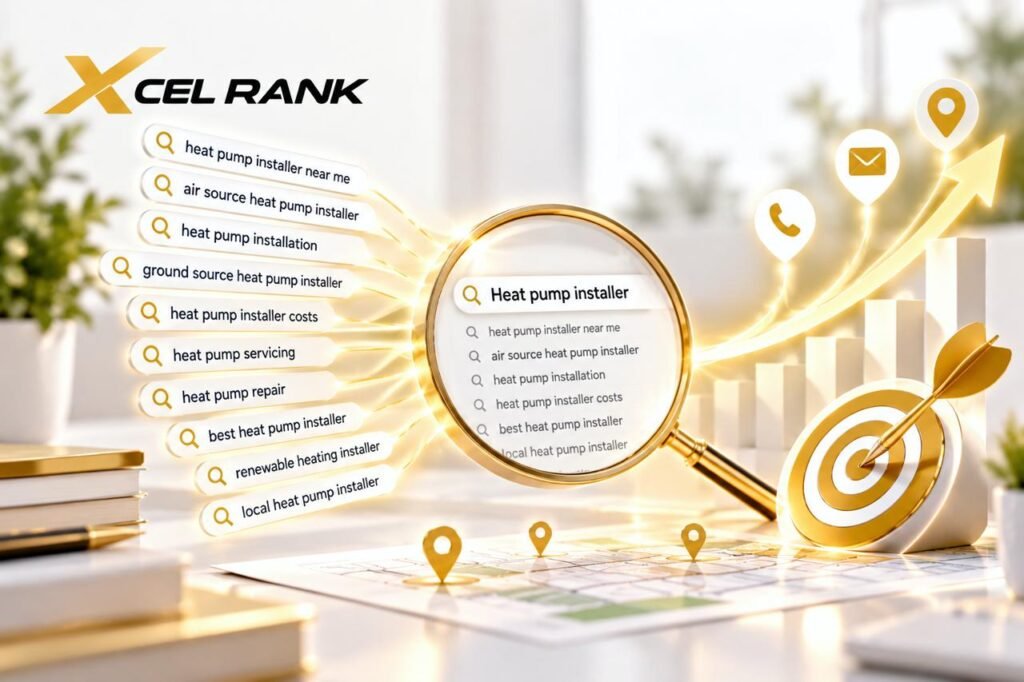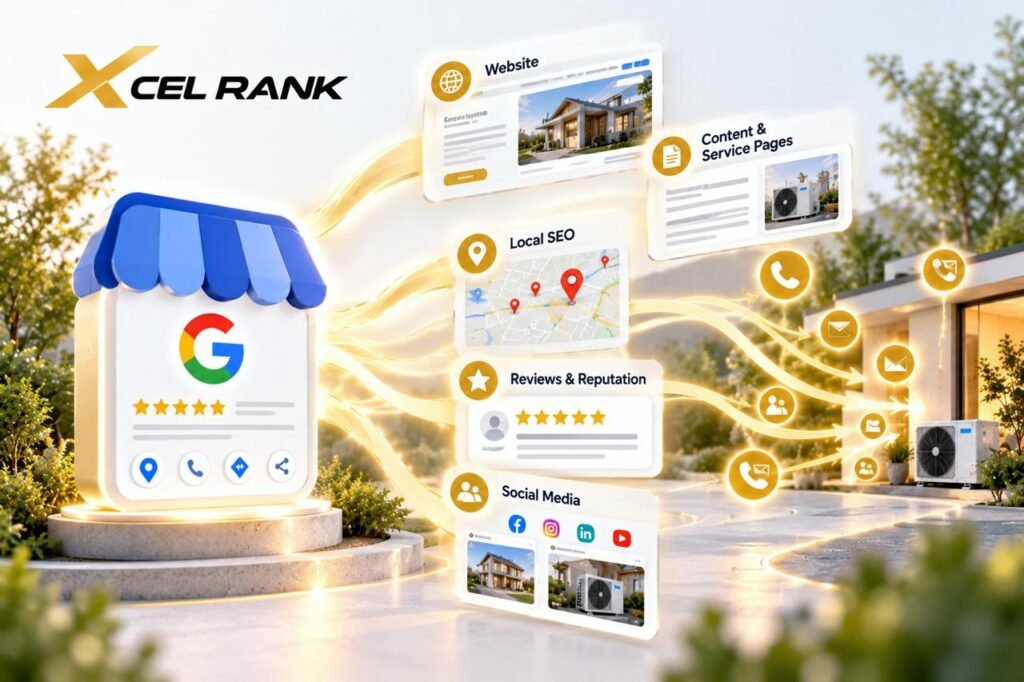
SEO for heat pump installers means being visible and credible at every stage of a homeowner’s research: Google Search, Google Maps, and increasingly AI-generated answers. Ranking for “heat pump installer near me” is only one part of it.
Homeowners considering an air source or ground source heat pump often spend weeks comparing installers, checking MCS certification, and working out whether they qualify for the Boiler Upgrade Scheme. This guide covers what moves the needle: your Google Business Profile, local SEO basics, content that answers real questions, and how AI search is changing who gets found.
Want to rank higher as a heat pump installer?
Get a free local SEO audit from Xcel Rank.
What Heat Pump Installer SEO Involves
It covers three connected areas: local visibility in the map pack, website content that answers grant and certification questions, and trust signals such as MCS registration, named engineers, and clear pricing.
Unlike general trades SEO, it has to deal with the MCS and Boiler Upgrade Scheme layer that many agencies oversimplify. Your site should explain what MCS certification means, who qualifies for funding, and what an installation involves. Listing “heat pump installation” next to boiler repairs doesn’t do that.
Why Heat Pump SEO Needs a Different Approach
The buying journey is longer than almost any other trade search. A homeowner with a working boiler isn’t in a hurry, so they research for weeks.
That has two effects:
- Informational content such as grant explainers and cost guides builds trust before anyone fills in a form
- Industry-specific trust signals matter most: your MCS registration number, your Nominated Technical Person’s qualifications, and a clear list of what a quote includes
A boiler site with “heat pump” swapped into the copy won’t convert this buyer.
Choose the Right Google Business Profile Category
Pick the closest literal match to what homeowners search, usually a heating or renewable energy category, not a broad label like “electrician” or “contractor.”
The closer the match, the more relevant Google considers your listing. Add secondary categories only for services you really sell, such as boiler installation or renewable heating. Stacking categories you don’t promote dilutes relevance.
Two other profile details matter just as much:
List the towns and postcodes you actually cover. If your website’s location pages don’t match your profile, that mismatch works against you.
Homeowners look for specifics, such as a thorough survey, transparent pricing, and install time. Encourage customers to mention the system type and any grant used.
Is your Google Business Profile set up right?
We’ll flag category, service area, or completeness issues before they cost you visibility.
How to Rank in the Google Maps Map Pack
Map pack ranking comes from three things working together: consistent business details everywhere, service area pages built for real local searches, and a steady flow of detailed reviews.
- Citation consistency. Your name, address, and phone number (NAP) must match across your website, profile, and directories, including the MCS installer search and the Heat Pump Association directory. Mismatches make Google less sure which business is yours.
- Pages for real local searches. One national page won’t beat installers who built pages for each town. Create one page per town or postcode cluster. Cover local costs, any regional scheme on top of the Boiler Upgrade Scheme, and real nearby projects. Never copy a page and swap the town name.
- Reviews as a ranking signal. Review count and recency both count. A steady trickle of new reviews usually beats a larger but stale total.
Content That Helps a Heat Pump Website Rank
The biggest gap in this niche is plain-English grant and certification content. Many installer sites mention the Boiler Upgrade Scheme in one sentence and move on, leaving real questions unanswered.
Homeowners want to know if they are eligible, how much they could get, and what the installer must do to claim it. Useful content includes:
- A Boiler Upgrade Scheme explainer covering eligibility, current grant amounts, and the fact that the installer applies for the voucher
- Air source vs ground source comparisons based on real trade-offs, such as space needed, running costs, and upfront price
- “Is my house suitable” guides covering insulation, radiator sizing, and property type
- Cost pages with realistic ranges, not just “request a quote”
- Case studies naming the property type, the system, and the result
Want pages that rank and convert?
Our Local SEO and AEO team builds service and location pages for heat pump installers.
How Is AI Search Changing Heat Pump SEO?
Homeowners now ask AI tools questions like “what does an air source heat pump cost in the UK” and get an answer before opening Google. Being cited in that answer matters as much as ranking. This is what people call AEO or GEO.
To improve your chances:
- Put a direct answer in the first sentence under each heading
- Write facts as clean, standalone sentences, such as the example below
- Use your own data where you can, like typical install times or costs in your area
- Add an FAQ section covering five to eight real questions
- Keep your company description and credentials identical on your website, profile, and directories
Why E-E-A-T Matters More for Heat Pump Content
A heat pump is an expensive, technical purchase most people make once. Google’s experience, expertise, authority, and trust signals therefore weigh more here than for many trades.
Practical ways to show them:
- Name your engineers and their MCS Nominated Technical Person qualifications
- State your MCS registration number on every service page, not only on the About page
- Be honest about limits, such as property types you don’t suit, lead times, and what a quote excludes
- Show your process: heat loss survey, design, DNO application where needed, installation, and handover
- Share pricing as ranges wherever you reasonably can
The Biggest SEO Mistakes Heat Pump Installers Make
The most common mistake is treating heat pumps as one line in a general boiler and heating list. They need dedicated, detailed pages.
Other mistakes to avoid:
Strong technical and local SEO is half the picture. The other half is content that answers what a homeowner researching a heat pump wants to know. To see where your site and profile stand, book a free audit with Xcel Rank and we’ll walk through what is working and what isn’t.
See where you stand today
A free audit shows exactly what to fix first.
Frequently Asked Questions
Does a heat pump installer need different SEO from a general plumbing and heating firm?
Yes. Heat pump customers research longer and look for MCS certification and Boiler Upgrade Scheme eligibility, so the content and trust signals that convert them differ from an emergency boiler search.
What Google Business Profile category should a heat pump installer use?
Choose the most specific category that matches what customers search, and add secondary categories only for services you actually deliver.
Does MCS certification affect Google rankings?
Not directly. Stating your MCS registration clearly does support trust signals, and homeowners check for it before they enquire.
How long does heat pump installer SEO take to show results?
Profile and local SEO improvements can show movement within a couple of months. Competitive content and authority take longer. Be wary of anyone guaranteeing a fixed number of leads.
Should service area pages be built per town or per region?
Per town or postcode cluster usually works better, as long as each page has distinct content.
Ready to get more heat pump enquiries from Google?
Book a free audit with Xcel Rank and we’ll show you exactly what to prioritise first.
Book my free audit