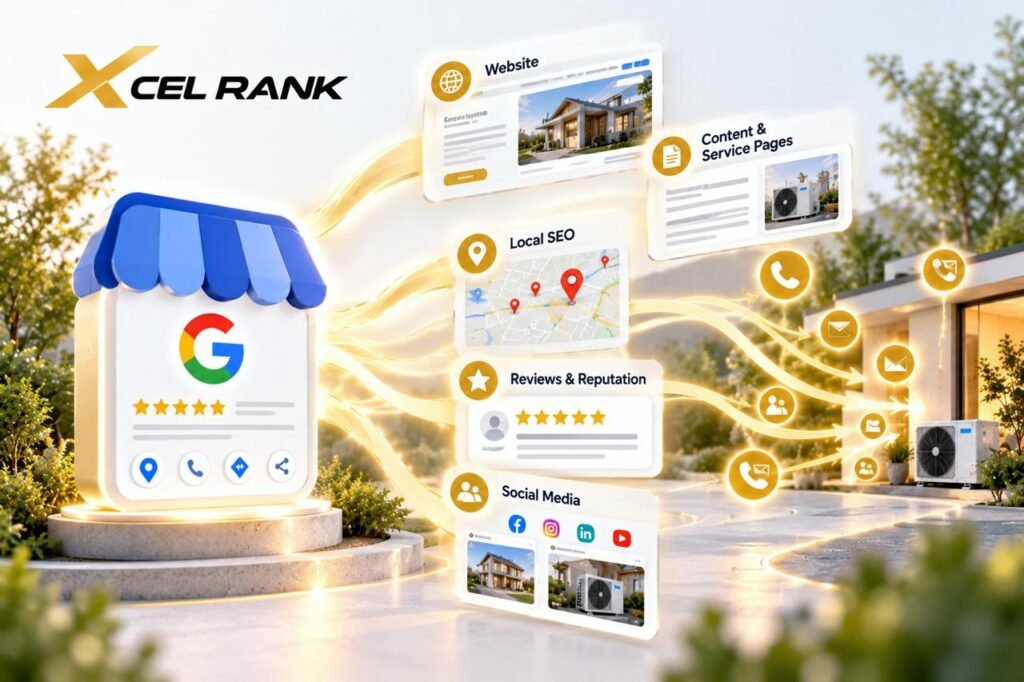
A Google Business Profile gets a heat pump installer seen, but it can’t do the whole job alone. Homeowners spending several thousand pounds want depth, proof, and clear answers, and that content lives on a website you own.
This guide explains what a profile can and can’t do, what your website adds, and how the two work together for local rankings and AI search.
Is your profile doing all the work?
Get a free local SEO audit from Xcel Rank.
What a Google Business Profile Does Well
A profile puts your business in the map pack and on Google Maps, with your reviews, photos, hours, and service areas visible at a glance. For many homeowners it is the first look at your company.
That first look matters. A complete profile with real project photos and recent reviews earns clicks and calls. It also feeds Google’s local ranking, which is why optimising it is the right starting point.
Where a Profile Falls Short
A profile is a short summary, not a full explanation. It can’t walk a homeowner through the Boiler Upgrade Scheme, compare air source and ground source systems, or explain what a heat loss survey involves.
Heat pump buyers research for weeks and ask detailed questions. Homeowners who want that depth leave the profile and look for it elsewhere.
Want the depth homeowners are looking for?
We’ll review your profile and website for free.
Why Do Heat Pump Installers Need a Website Too?
A website gives you space to build trust and answer questions in full. It is also the one platform you control completely.
A suspension, a policy change, or a layout update can reduce your visibility overnight. Social media pages carry the same risk. A website keeps your content, your contact route, and your customer journey in your own hands.
It also helps Google rank you. Google checks your site to confirm the profile is accurate, and it uses your pages for relevance. Backlinks to your website from trade bodies, local news, or manufacturer “find an installer” pages build prominence, which a profile alone can’t collect.
What Your Website Should Add
Aim for pages that answer what a profile can’t:
- Service pages for air source and ground source installation
- Boiler Upgrade Scheme content covering eligibility and how an MCS installer handles the grant
- Cost pages with realistic ranges and what affects them
- Air source vs ground source comparisons based on real trade-offs
- Case studies naming the property type, system, and outcome
- Location pages for each town you genuinely cover
Each page should state its main answer in the first two or three sentences, so homeowners and AI tools can use it straight away.
How the Profile and Website Work Together
Your profile brings local attention, and your website closes the decision.
Keep your name, address, and phone number (NAP), service areas, and MCS details identical on both. Google cross-checks them, and a mismatch can weaken rankings. Link your profile to the matching service page, and mention the same towns on both.
| Google Business Profile | Website | |
|---|---|---|
| Main job | Local visibility and first impression | Depth, trust, and conversion |
| Strength | Reviews, photos, map pack | Detailed answers and case studies |
| Limit | Short summary, controlled by Google | Needs content and upkeep |
| Control | You |
Want pages that rank and convert?
Our Local SEO and AEO team builds service and location pages for heat pump installers.
What This Means for AI Search
AI Overviews, ChatGPT, and Gemini draw on both your profile data and your website content when they recommend local installers.
A profile gives them your location and reviews. A website gives them citable facts, such as grant details, cost ranges, and your MCS registration. Add LocalBusiness and FAQPage schema so those details are easy to read. Using both gives AI systems more reasons to name you.
A strong profile and a strong website make each other work harder. To see where yours stand, book a free audit with Xcel Rank and we’ll show you what to prioritise first.
See where you stand today
A free audit shows exactly what to fix first.
Frequently Asked Questions
Can a heat pump installer rely on a Google Business Profile alone?
It can bring some enquiries, but it gives you little room to explain grants, costs, and system choices, and Google controls it.
Does a website help my Google Business Profile rank?
Yes. Google uses your site to confirm your details and judge relevance, and backlinks to it add prominence.
Is a social media page a good substitute for a website?
No. Social pages carry the same platform risk as a profile and offer little space for detailed answers.
What should be on a heat pump installer’s website first?
Dedicated air source and ground source service pages, a Boiler Upgrade Scheme explainer, and a cost page with realistic ranges.
Do I need to keep details the same on my profile and website?
Yes. Matching NAP, service areas, and MCS information supports trust with Google and AI tools.
Ready to get more heat pump enquiries from Google?
Book a free audit with Xcel Rank and we’ll show you exactly what to prioritise first.
Book my free audit