
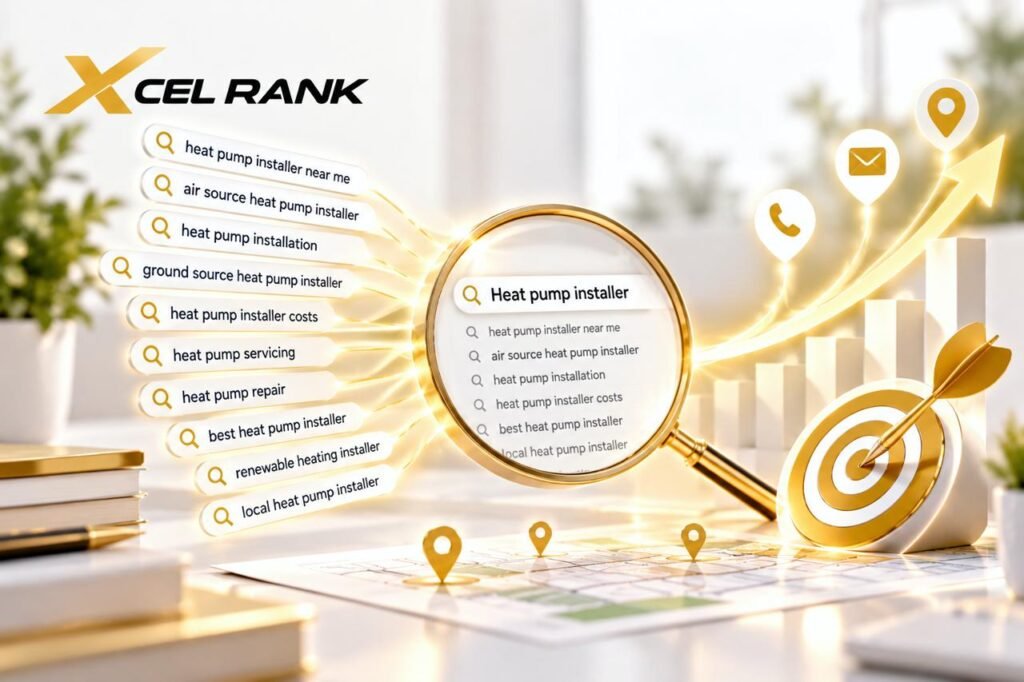
The best keywords for heat pump installer businesses combine a service, a place, and a buying stage, such as “air source heat pump installer Leeds” rather than just “heat pump”. Target a small set of these, give each its own page, and check demand in your own area before you commit.
This guide covers the keyword types worth targeting, how to match them to what homeowners are ready to do, and how to find the terms people in your area actually search.
Not sure which keywords to target?
Get a free local SEO audit from Xcel Rank.
Which Keywords Should a Heat Pump Installer Target First?
Start with service plus location keywords, because they come from homeowners who are close to asking for quotes. Examples include “air source heat pump installer Bristol” and “ground source heat pump installation Cheshire”.
Broad terms like “heat pump” on its own mostly attract people researching from anywhere in the UK, and the results are usually crowded with national brands, manufacturers, and comparison sites. A local installer has a far better chance with a specific service in a place it genuinely covers.
Keyword Types Worth Targeting
Heat pump searches fall into a handful of groups, and each one belongs on a different page. Mixing them on one page makes it harder for Google to tell what the page is for.
| Keyword type | Example | Where to use it |
|---|---|---|
| Service and location | “air source heat pump installer Leeds” | Service or location page |
| Ground source | “ground source heat pump installation Cheshire” | Dedicated service page |
| Grant and funding | “Boiler Upgrade Scheme installer” | Grant explainer page |
| Cost | “how much does an air source heat pump cost” | Cost guide |
| Comparison | “air source vs ground source heat pump” | Comparison guide |
| Servicing | “heat pump servicing near me” | Servicing page |
| Accreditation | “MCS certified heat pump installer” | Home page and service pages |
| Brand | “Vaillant heat pump installer” | Brand page, if you are an approved installer |
Servicing is easy to overlook. Homeowners who already have a heat pump search for maintenance too, and those searches often face less competition than new installations.
Match Keywords to the Buying Stage
Every keyword reflects how close the homeowner is to a decision, and the page should respond to that. A quote request suits some pages, while others should lead gently towards a survey.
- Ready to buy: service plus location searches. Lead with accreditation, a price indication, and a quote request.
- Comparing options: cost, grant, and comparison searches. Answer the question clearly, then offer a heat loss survey.
- Researching: “how does a heat pump work” or “do heat pumps work in older homes”. Educate first, and keep the call to action soft.
Want a keyword plan for your area?
We’ll check your current pages and keywords for free.
How To Find the Keywords People Search in Your Area
Use your own data first, then compare it with what the market shows. This keeps you from chasing terms that look good in a tool but don’t match your customers.
- Check Google Search Console for queries that already bring people to your website
- Look at the search terms report in your Google Business Profile performance data
- Type your main services into Google and note the autocomplete suggestions and People Also Ask questions
- Look at the headings and page titles of competing installers in your area
- Use a keyword tool such as Google Keyword Planner to compare demand, treating the numbers as estimates rather than exact figures
Keywords To Be Careful With
Some keywords bring traffic that never turns into work. Check each one against the jobs you actually want.
- “Heat pump” on its own: broad, mostly research, and dominated by larger sites
- Areas you don’t genuinely cover: they waste clicks and can mislead homeowners
- “Cheap” or “lowest price” terms: they tend to attract price-first enquiries rather than the projects you want
- Several main keywords on one page: your own pages end up competing with each other
Using Keywords on the Page and in AI Search
Give each page one main keyword and write everything else naturally around it. Put that keyword in the page title, the main heading, and the first paragraph, and use plain variations further down instead of repeating it.
AI tools like Google AI Overviews, ChatGPT, and Gemini work from questions, so phrase some headings the way homeowners ask them, such as “how much does a heat pump cost to run”. Open each section with a short, direct answer, and add FAQPage schema so those answers are easy to read.
Choosing keywords is only the first step, and the pages built around them need ongoing refinement. To see which keywords fit your area, book a free audit with Xcel Rank and we’ll show you what to prioritise first.
Want pages that rank and convert?
Our Local SEO and AEO team builds service and location pages for heat pump installers.
Frequently Asked Questions
What is the best keyword for a heat pump installer to target?
There isn’t one single best keyword. The strongest choice is a specific service plus a place you cover, such as “air source heat pump installer” and your town, matched to a page you have actually built.
Should I target “heat pump installer near me” directly?
Not as literal page copy. Google treats “near me” as a location signal from the searcher’s device, so your effort is better spent on your Google Business Profile, reviews, and local pages.
How many keywords should one page target?
One main keyword, plus natural variations of it. Targeting several unrelated keywords on one page makes the page less clear for both homeowners and Google.
Are grant keywords worth targeting?
Yes, because homeowners ask about funding early. Check eligibility details against official guidance before publishing, since grant rules can change.
How often should I review my keywords?
Every few months is a sensible rhythm. Search Console shows new queries over time, and your service areas or offers may change too.
Ready to get more heat pump enquiries from Google?
Book a free audit with Xcel Rank and we’ll show you exactly what to prioritise first.
Book my free audit