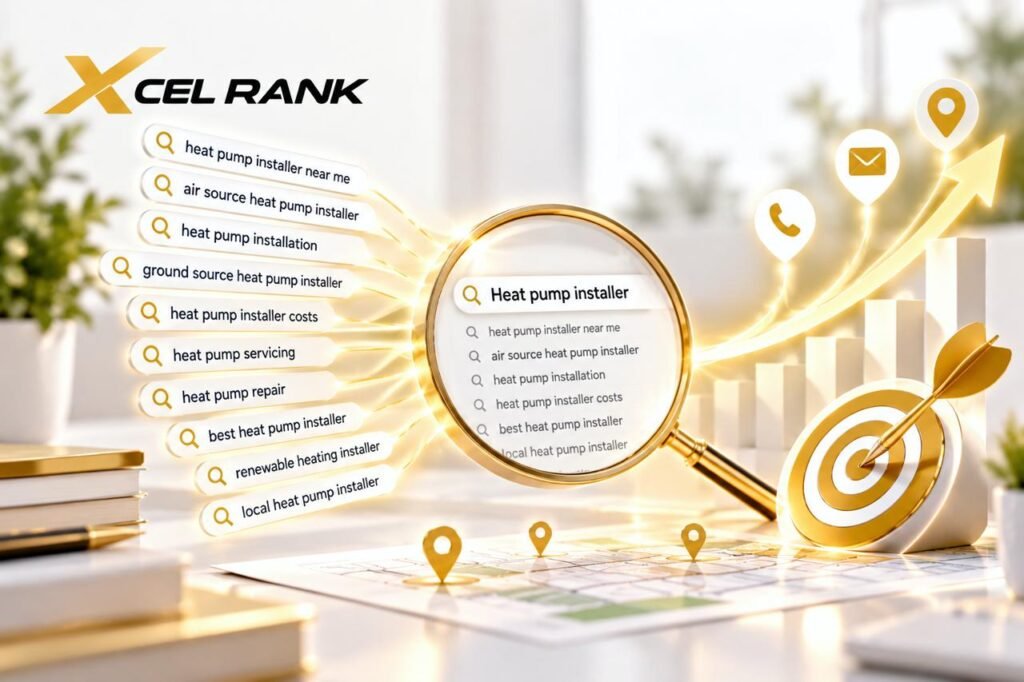

A heat pump service page ranks when it does four things: names the exact service and area in the headline, answers what the service involves and roughly what it costs near the top, shows real process and accreditation detail, and backs it up with proof from actual jobs. Build each page around one main keyword, not several competing ones.
This guide walks through one page from its first line to its FAQ, with air source and ground source installation pages as the main examples.
Not sure your service pages are working?
Get a free local SEO audit from Xcel Rank.
Why Generic Service Pages Struggle to Rank
A single “Our Services” page that covers air source, ground source, and servicing in a few lines each rarely ranks for any of them. Google can’t match it to a specific search like “ground source heat pump installer Cheshire”.
Give each service its own page: air source installation, ground source installation, and servicing. Each page then matches one search and speaks directly to the homeowner who typed it. Don’t merge installation and servicing either. Someone needing an annual service has a different goal from someone researching a new install, and one page rarely satisfies both.
Open With the Answer
Use the first two or three sentences to say what the service is, who it is for, and how long or how much. Homeowners and Google AI Overviews both look for this first.
A ground source page might open:
That one sentence covers the service, area, accreditation, and timing. A paragraph on the general benefits of renewable heating covers none of them.
AI Overviews prefer short, self-contained answers near the top. A page that states its key facts early is more likely to be cited for related questions.
How Much Should a Service Page Say About Price?
Some indication, even without exact figures. Saying nothing about cost loses enquiries, and so does a misleading fixed price.
A typical range, a starting price, or a plain explanation of what changes the cost is enough. Useful factors include property size, the existing heating system, and groundworks needed. Showing the current Boiler Upgrade Scheme grant next to a typical net cost is one of the strongest trust signals you can add. It tells the homeowner you handle the grant, so they don’t have to work it out alone.
Show the Process Step by Step
Most homeowners have never had a heat pump fitted, so a numbered process calms their nerves. It also suits “how does it work” searches. Keep each step to one sentence so it reads easily on a phone, where much of this research happens.
- Survey and heat loss calculation for the property
- Written quote with system specification and net cost after any grant
- Installation, completed within an agreed number of days
- Commissioning and handover, including a walkthrough of the controls
- MCS registration and grant paperwork completed
Prove It With Specific Detail
Phrases like “years of experience” or “trusted local installer” say little to homeowners or Google. Specifics work better: your MCS certification number, the actual towns you serve, and a real case study.
A short case study with a property type and outcome shows real skill. Good examples are an older solid-wall house, a tight space for groundworks, or a switch from an oil boiler. Naming the engineer who designed or commissioned the system adds accountability that homeowners notice.
| Page element | What it solves | Where it goes |
|---|---|---|
| Direct opening answer | Matches the page to the search | First two or three sentences |
| Price range or starting cost | Lets homeowners self-qualify | Near the top |
| Step-by-step process | Builds confidence | Middle of the page |
| MCS details and case studies | Adds verifiable trust | Throughout, plus one section |
| One clear call to action | Gives one obvious next step | After the intro and at the end |
Is your service page built to convert?
We’ll review your heat pump pages for free.
Keep One Call to Action
Point each page toward a single next step, usually a quote request or a booked survey. Too many options split attention.
Place a soft prompt after the intro, such as “Get a free heat loss survey”, and a firmer one at the end. That gives homeowners a natural moment to act without pressure while they’re still reading.
Pages that combine trust signals with the structure Google and AI Overviews look for need ongoing refinement. A Local SEO and AEO partner like Xcel Rank can help heat pump installers get that balance right.
Want pages that rank and convert?
Our Local SEO and AEO team builds service and location pages for heat pump installers.
Frequently Asked Questions
Should air source and ground source heat pumps have separate pages?
Yes. The systems differ in installation and cost, and separate pages let each rank for its own search instead of competing.
Do service pages need to show prices?
Not exact prices, but a typical range or starting cost helps homeowners self-qualify and usually improves enquiry quality.
How long should a heat pump service page be?
There is no fixed length. Several hundred words of specific, useful detail beats padding.
What should the call to action say?
Something specific and low-pressure, like “Get a free heat loss survey” or “Request a written quote”, rather than a generic “Contact us”.
Do service pages need an FAQ section?
Yes. A short FAQ on timelines or grant eligibility reassures homeowners and gives Google clear content to match.
Ready to get more heat pump enquiries from Google?
Book a free audit with Xcel Rank and we’ll show you exactly what to prioritise first.
Book my free audit