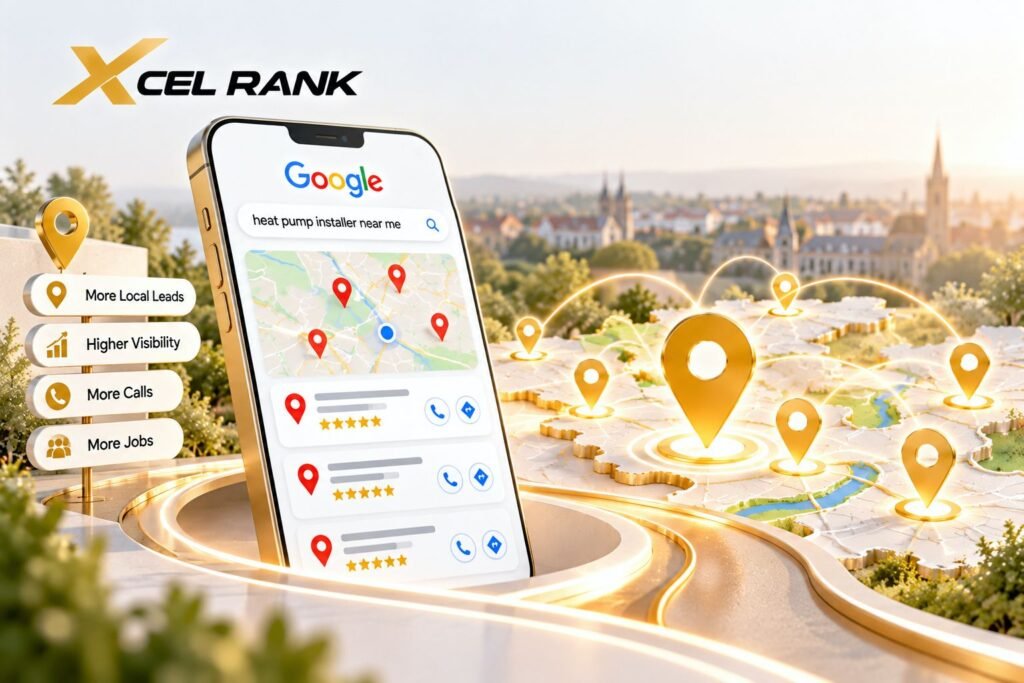
Local SEO for heat pump installers means appearing in Google’s local pack, on Google Maps, and in “near me” searches for every town you serve. It rests on three foundations: an optimised Google Business Profile, consistent directory citations, and content written for each area.
This guide shows how to build each one, which directories are worth your time, and which mistakes keep installers invisible outside their home town.
Want to be found in every town you serve?
Get a free local SEO audit from Xcel Rank.
Why Local Intent Matters So Much for Heat Pump Installers
Heat pump searches carry strong local intent, and homeowners rarely look past the first few results for a job this size. Many “near me” searches end in contact within a day.
Your ranking also depends on Google recognising which towns and postcodes you cover, not just that you exist. An installer serving six towns from one base needs clear, consistent evidence of coverage in each place. Google, homeowners, and AI search tools all look for it.
How Do You Get Found on Google Maps?
Combine a complete Google Business Profile with genuine service area coverage. Google needs a confident category match and proof that you work where you claim.
Three things matter most:
Choose the closest match to what homeowners search, not a broad label like “contractor”. It is the biggest driver of local pack visibility.
List the towns and postcodes you really cover. A wide radius you don’t serve creates a mismatch Google can penalise.
Photos of finished installs and occasional posts, such as a new area or a Boiler Upgrade Scheme update, show the listing is active.
Which Directories Help Heat Pump Installers?
Free general directories build citation consistency, while paid trade directories build homeowner trust. Both help, but they do different jobs.
Free UK directories such as Bing Places, Yell, Thomson Local, and a Facebook Business Page confirm your name, address, and phone number (NAP) match everywhere. Google cross-checks this, and even a small difference like an abbreviated street name can raise doubt.
Trade directories like Checkatrade, TrustATrader, and Rated People carry more weight with homeowners because they centre on verified reviews. Most charge a subscription or per lead, so test them as a measurable channel rather than assuming they are essential.
Sector listings matter most for heat pump work. Your entry on the MCS installer search and a Heat Pump Association listing signal real industry credentials that a generic directory can’t.
Choose quality over quantity. A few accurate, relevant listings beat dozens of poor ones with inconsistent details.
| Directory type | Examples | Best for |
|---|---|---|
| Free general | Bing Places, Yell, Thomson Local, Facebook | NAP consistency and baseline citations |
| Paid trade | Checkatrade, TrustATrader, Rated People | Homeowner trust and verified reviews |
| Sector-specific | MCS installer search, Heat Pump Association | Industry legitimacy |
Are your listings consistent?
We’ll check your citations and profile for free.
Write Separate Content for Each Town
Build one distinct page per town or postcode cluster. Copying one page and swapping the town name usually underperforms and can hold back all the versions.
A strong local page includes:
- Case studies from that area, with the property type named
- Any regional funding alongside the national Boiler Upgrade Scheme grant
- Local detail, such as common house types or planning points for the region
- One clear next step, like a survey booking or contact form
Your Google Business Profile gets you seen, but the page a homeowner lands on still has to answer their question. That is where local SEO joins your wider SEO strategy for heat pump installers.
Want pages that rank and convert?
Our Local SEO and AEO team builds service and location pages for heat pump installers.
How Local SEO Supports AI Search
AI tools such as Google AI Overviews and ChatGPT increasingly answer questions like “best heat pump installer near me” directly. They use the same consistency signals as local SEO.
Keep your business description, service areas, and MCS registration identical across your website, Google Business Profile, and directories. Add LocalBusiness schema so your details are easy for machines to read. The groundwork that supports your local pack ranking also helps AI systems name you in an answer.
Getting found locally needs profile, citations, and content working together. To see where you stand on each, book a free local SEO audit with Xcel Rank and we’ll show you what to prioritise first.
See where you stand today
A free audit shows exactly what to fix first.
Frequently Asked Questions
How many citations does a heat pump installer need?
There is no fixed number. A smaller set of accurate listings, including general directories and sector ones like the MCS installer search, beats many inconsistent ones.
Is Checkatrade worth it for a heat pump installer?
It can be, because homeowners trust it. It works more like a paid lead channel than an SEO tool, so test and measure it.
Should I build a page for every town I serve?
Yes, if each page has distinct, useful content. A template with only the town name changed tends to underperform.
Should my service area match my website exactly?
Yes. A mismatch between the areas on your profile and your site creates ambiguity that can hold back rankings.
How long does local SEO take to work?
Profile improvements can show movement within a couple of months. Citations and local content take longer. Be wary of fixed-timeline promises.
Ready to get more heat pump enquiries from Google?
Book a free audit with Xcel Rank and we’ll show you exactly what to prioritise first.
Book my free audit